
𝐂𝐚𝐫𝐞𝐞𝐫 𝐂𝐡𝐚𝐧𝐠𝐞 𝐈𝐬 𝐍𝐨𝐭 𝐀𝐛𝐨𝐮𝐭 𝐅𝐢𝐧𝐝𝐢𝐧𝐠 𝐘𝐨𝐮𝐫𝐬𝐞𝐥𝐟 (Part 1/2)
As part of the transition coaching work I do, some clients come specifically for a career transition. But whether it is a career transition or a life transition, what is really happening underneath is often a shift of identity.
And this is precisely why many traditional career transition models do not work well — especially in moments of uncertainty, burnout, redundancy, plateau, or industry disruption.
The conventional approach tends to follow the following logic:
First introspect => Discover your “true self” => Define a clear goal => Then execute the plan.
On paper, it sounds rational, but in reality, it is often paralysing and ineffective.
Let’s explore why?
When people face a career crisis, they usually turn inward. They take personality tests, list their strengths and passions, and try to identify the “perfect next role” that matches who they supposedly are or believe themselves to be.
The problem is that the idea of a single “true self” is largely a myth, and what seems to be a constant and fixed self is, in fact, fluid and changing.
We are not one fixed identity waiting to be uncovered. We are multiple selves, emerging through context, action, relationships, and experience.
And our possible selves — the identities we could potentially grow into — are often vague, undiscovered, or constrained by our past experiences and social conditioning.
Career reinvention is therefore not primarily an act of logical deduction, but it is an act of experimentation intended to reveal through experience the nature of these possible selves.
Very often in life, we rarely “know then do.”
More often, we “do then know.”
The people who navigate transition most effectively tend to test, explore, prototype, and adapt. They try new roles, projects, conversations, environments, ways of relating and working — often on a small scale first. And this is what best defines the “in-between” chapter period (see for more: https://outofchoice.co/the-4-stages-of-transition/)
Then, through those lived experiences, a new identity begins to take shape.
So the invitation is to treat identity not as something fixed to discover, but as a hypothesis to test.
Successful reinvention is not just about changing what you do. It is really about changing who you are becoming.
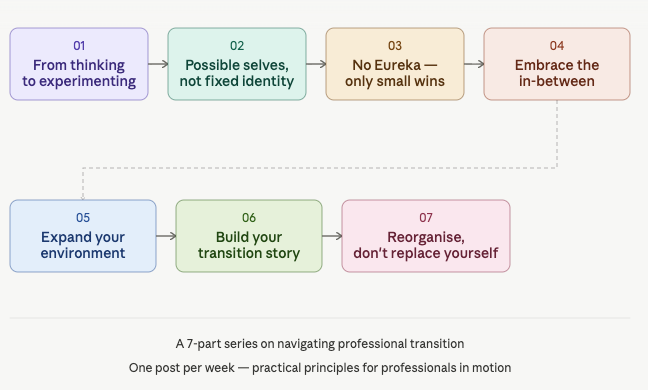
Part 2 will explore some practical high-level steps to navigate this process more effectively.