
𝐂𝐚𝐫𝐞𝐞𝐫 𝐭𝐫𝐚𝐧𝐬𝐢𝐭𝐢𝐨𝐧 – 𝐰𝐡𝐚𝐭 𝐲𝐨𝐮 𝐜𝐚𝐧 𝐝𝐨 𝐭𝐨 𝐡𝐞𝐥𝐩 𝐲𝐨𝐮𝐫𝐬𝐞𝐥𝐟? (𝐩𝐚𝐫𝐭 2/3)
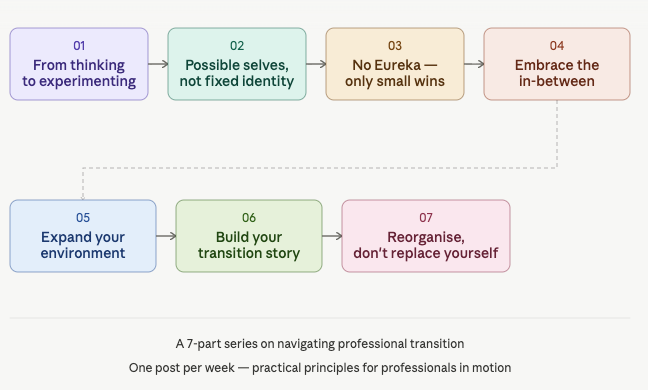
A few principles I consistently see helping people navigate transition more effectively:
1. Shift from “What can I do?” to “What can I try?”
Most people approach transition intellectually, trying to think their way toward certainty before taking action.
Ask yourself:
“What small experiment can I run?”
It can be a conversation, a project, a course, a collaboration, or a temporary role.
Clarity often emerges through movement, not before it.
2. Stop searching for your “true self.”
Explore your ” possible selves instead.”:
Who could you become?
What do you hope to become?
What do you fear becoming?
Possible selves are provisional, playful, and open to revision.
They are not fixed conclusions. They are working hypotheses.
3. There is rarely an Eureka moment.
Most career transitions do not happen through a single grand insight but emerge from “small wins,” such as a meaningful conversation, a new perspective, a moment of resonance, or even a tiny increase in confidence.
Small concrete steps create momentum that shifts identity.
4. Step out — but do not tune out
Transition often requires “le pas de côté” — stepping sideways out of automatic patterns. This “in-between” phase matters deeply because the old identity no longer fully fits while the new one has not yet stabilised. (more about this here: https://outofchoice.co/transition-3-levels-reality/)
5. Do not do it alone
Identity is socially reinforced, and your current environment often keeps confirming your current identity. Current people in your life may unconsciously pressure you to remain who you have always been.
Seek out people who are already exploring what interests you.
Find mentors, peers, communities, or a coach who can help you test and reflect without collapsing back into old narratives.
6. Learn to develop your story
As you experiment, you will need to explain your transition — not only to others, but also to yourself. Your story will evolve. And that is normal.
7. Many people approach reinvention with an “all-or-nothing” mindset.
But identity transition is rarely clean-cut.
You are not instantly becoming someone entirely different.
Parts of who you have been remain valuable. Other parts evolve. New dimensions emerge.
The process is often less about replacing yourself and more about reorganising yourself.
Thinking, reflecting, and acting must happen simultaneously and not sequentially.
In conclusion, reinvention is less about certainty and more about adaptive movement. And perhaps that is why transition feels so uncomfortable:
because we are trying to become someone before fully knowing who that person is.