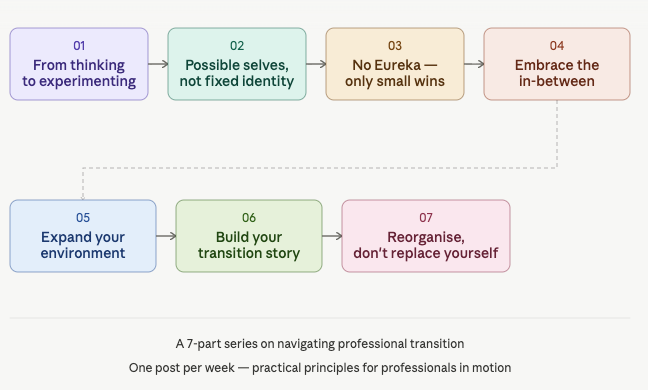
Career Transition -𝐘𝐨𝐮𝐫 𝐭𝐫𝐚𝐧𝐬𝐢𝐭𝐢𝐨𝐧 𝐬𝐭𝐨𝐫𝐲 𝐦𝐚𝐭𝐭𝐞𝐫𝐬 𝐦𝐨𝐫𝐞 𝐭𝐡𝐚𝐧 𝐲𝐨𝐮𝐫 𝐂𝐕 (6/7)
At some point in your transition, you will have to explain what is happening to others – a recruiter, a friend, a family member, a potential collaborator, or a new network contact… And more importantly, to yourself.
Most people dread this moment as they stumble over the gap, they over-explain the pivot, or even apologise for the non-linear path.
But here is what I have observed: the professionals who navigate transition most successfully are not the ones with the cleanest trajectories, but the ones who have learned 𝒕𝒐 𝒕𝒆𝒍𝒍 𝒂 𝒄𝒐𝒉𝒆𝒓𝒆𝒏𝒕 𝒔𝒕𝒐𝒓𝒚.
Your story does not need to be linear. It needs to be intentional, authentic, and resonate with you when you tell it.
Instead of “I ended up here by accident,” … be able to explain “Here is what I was learning, what shifted, and where I am going.”
A few principles for building your transition narrative:
- Own the pivot. A deliberate change signals self-awareness and agency, not confusion. Frame it as a choice, not a drift.
- Connect the threads. Your past experience is not irrelevant — it is the foundation. What skills, values, and perspectives are you carrying forward?
- Name what you are moving toward. Uncertainty is fine; directionlessness is not. You do not need all the answers, but you need a credible “next chapter.”
Expect the story to evolve. What you say in month two of your transition will be different from month ten. That is not an inconsistency; that is journeying through life.
Your story will not be perfect immediately. It will be worked and reworked, but the act of articulating it — out loud, to others — is itself part of how the new identity solidifies.
→ How do you currently describe your transition to someone new? Is it the story you want to be telling?